






How stable value funds work
With more than $850 billion¹ in defined contribution assets, stable value funds are popular capital-preservation choices for tax-qualified employer-sponsored plans. They seek to provide participants with principal protection, consistent returns, and steady income. But how do they work? Learn more to see if stable value funds are right for your plan.
.png)
[Updated article; original publish date 1/22/20]
Stable value funds can be an attractive alternative to other capital preservation vehicles, such as money market funds. They work by combining a diversified portfolio of high-quality, short- to intermediate-term bonds with insurance or bank guarantees that aim to deliver steady, predictable returns with low volatility. The following glossary of terms can help you better understand how stable value funds work.
Glossary of terms
- Average credit quality—A measure of the financial soundness of an institution, indicating its ability to honor its financial obligations in a timely manner. Firms known as NRSROs assign quality ratings on banks, insurance companies, and other entities based on multiple factors, including financial health, industry outlook, balance sheet, and quality management. A credit quality rating may also be assigned to a specific financial instrument.
- Benefit-responsive—The ability to transact at book or contract value for benefit payments
- Book (contract) value—The amount a stable value contract is worth based on the initial deposit (principal) plus interest earned, minus withdrawals and expenses. The total represents what the issuer owes the plan, on behalf of its participants, under the terms of the contract. Investments using book or contract value can provide steadier, more predictable returns with lower volatility than market-value transactions, which use current market prices that change daily.
- Crediting rate—The interest rate applied to the book (contract) value of a stable value investment, typically expressed as the effective annual yield. The crediting rate may remain fixed for the term of the contract or can be reset at predetermined intervals and can be quoted before or after fees (gross or net, respectively). For separate account GICs or synthetic GICs, the crediting rate helps smooth out (amortize) the differences between the book value and market value over time.
- Contract-holder—The owner of a stable value contract, typically the plan sponsor or trustee, is usually the party responsible for taking any actions allowed or required under the terms of such contract.
- Guaranteed investment contracts (GICs)—An agreement with an insurance company or financial institution that guarantees a stated rate of return on contributions for a set period and the repayment of principal, subject to the contract’s terms and the issuer’s claims-paying ability.
- General account—A life insurance company investment account, typically invested in stocks, bonds, cash, and real estate, which holds the insurance company’s own assets, capital, surplus, and reserves against its liabilities.
- Liquidity—Generally, liquidity is the degree to which an investment can be easily sold or converted into cash, especially without affecting the investment’s price. In a stable value fund, it determines the participant’s ability to access funds without market value risk or other penalties.
- Market-to-book value—The market value of a fund’s underlying securities compared to the fund’s book value.
- Money market funds—Funds that invest in short-term securities that offer capital preservation, daily liquidity, and modest income. Priced at market value, money market yields change quickly based on short-term interest rates.
- Synthetic GICs—A synthetic GIC is a stable value investment structure designed to function like a traditional GIC, while allowing the plan to own the underlying assets. It targets a specified rate of return over a stated period, is benefit‑responsive, and uses book value accounting. The structure has two components:
- Asset ownership—A diversified, high‑quality fixed income portfolio (e.g., Treasury, government, mortgage, and corporate securities) owned by the plan or its trustee
- Contractual (wrap)—An agreement intended to support book value accounting for participant transactions
To meet the book-value obligation, the contract‑holder relies first on the value of the associated assets and, if those are insufficient, on the financial backing of the wrap issuer. Wrap contracts may be issued by banks, insurance companies, and other financial institutions.
- Wrap contracts—A stable value agreement from a bank, insurance company, or other financial institution that “wraps” a bond portfolio to:
- Protect principal and accumulated interest
- Guarantee a minimum interest rate (often not less than 0.00%) for a set period (the crediting rate)
- Allow participant withdrawals and transfers at book value, subject to contract terms
Stable value funds vs. other investments
(Performance for the 15-year period ended 12/31/25)
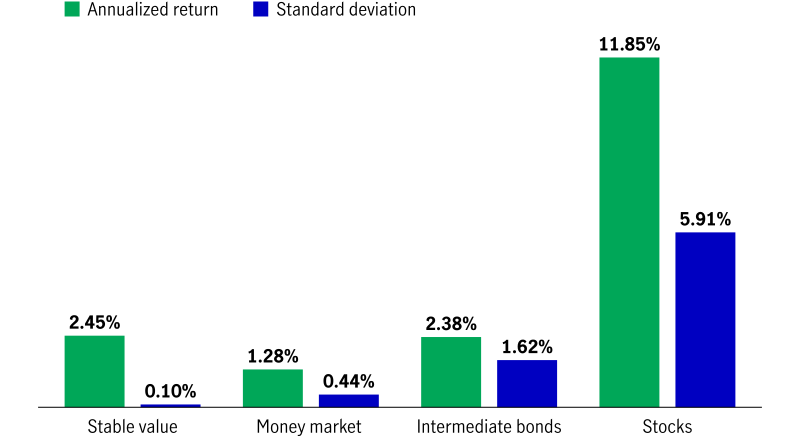
Stable value funds posted an annualized return of 2.45% over the 15-year period ended December 31, 2025, outperforming money market funds and intermediate bonds with lower volatility, as measured by standard deviation.
Types of stable value funds
Stable value funds generally fall into two types:
- Insurance company stable value accounts—These are backed by an insurance company’s general account and offered through a group annuity contract. The insurer guarantees the crediting rate, regardless of the market value of the underlying bond portfolio, maintains a steady price, and provides liquidity. The fund’s safety depends on the insurance company's financial strength.
- Commingled (or pooled) stable value funds—These funds invest in a diversified bond portfolio supported by insurance or bank-backed wrap contracts. They offer book-value transactions, with safety based on the strength of the underlying insurers or banks, which may include multiple guarantors.
| Insurance company account | Commingled fund |
Structure | Group annuity contract | Collective investment trust and/or a pooled separate account subscription agreement |
Portfolio | Insurance company’s general account | Typically, a diversified portfolio of primarily investment-grade fixed-income securities |
Plan-level withdrawal provisions | May be subject to a market value adjustment or holding period | May be subject to a market value adjustment or holding period |
Crediting rate | Determined by the guarantor | Typically follows an industry-standard formula |
Minimum crediting rate | Typically, 1.00% or higher | Typically, 0.00% |
Guarantee backed by | Financial strength and claims-paying ability of the guarantor | Financial strength and claims-paying ability of insurance companies and/or banks that guarantee the principal |
Key takeaways for plan sponsors
ERISA provision 404(c) requires fiduciaries to provide a broad range of investments in a plan, including a capital preservation option. Stable value funds can help you meet this requirement with some unique advantages.
- Stable value funds typically aim to provide yields above those of money market funds with comparable low volatility, which can help participants grow savings more effectively.
- Over the long term (10 to 15 years), stable value funds have generally outperformed money market funds.
- Wrap contracts enable book-value transactions to be priced at a constant $1.00 net asset value (NAV) per share, which protects participants from the daily pricing changes in the public markets.
Now that you’re more familiar with stable value funds, consider talking with your financial professional to explore your plan options.
FAQs
What’s a stable value fund?
A stable value fund is a low‑risk investment option for qualified retirement plans, including 401(k)s. They typically invest in a mix of high-quality, short- to intermediate-term bonds, paired with bank or insurance wrap contracts, which aim to protect principal and guarantee a steady, predictable return for participants.
How does stable value differ from money market funds?
Stable value funds transact at book value, or at a constant price, with wrap protections that deliver steady returns. They also potentially have higher yields with low risk due to their flexibility to invest in various duration bands (maturity range of bond holdings, e.g., 1 to 3 years), sectors, and credit quality tranches (different layers of risk or credit quality) within the U.S. bond market. Money market funds transact at market value, meaning their yields rise and fall in response to daily interest-rate changes.
Can participants move money in and out daily?
Yes, stable value funds typically offer daily liquidity at a constant $1.00 NAV per share, subject to contract and plan rules. This typically requires a 90-day equity wash, during which the participant transfers their stable-value investment to a non-competing fund for 90 days.
Who offers stable value funds?
Insurance companies and asset managers offer them through employer‑sponsored plans, either as insurance company accounts or commingled/pooled funds.
What can stable value funds offer DC plans?
Stable value funds satisfy the ERISA 404(c) requirement to include a capital preservation option in tax-advantaged retirement plans, such as 401(k)s, and can deliver higher returns with similar low volatility compared to money market funds over the long term (10 to 15 years).
For complete information about a particular investment option, please read the fund prospectus or fund offering document/trust document. You should carefully consider the objectives, risks, charges and expenses before investing. The prospectus or fund offering document/trust document contains this and other important information about the investment option and investment company. Please read the prospectus or fund offering document/trust document carefully before you invest or send money. Prospectus or fund offering document/trust document may only be available in English.
Investing involves risks, including the potential loss of principal. There is no guarantee that any investment strategy will achieve its objectives.
Stable value portfolios typically are invested in a diversified portfolio of bonds and entered into wrapper agreements with financial companies to prevent fluctuations in their share prices. Although a portfolio will seek to maintain a stable value, there is a risk that it will not be able to do so, and participants may lose their investment if both the fund's investment portfolio and the wrapper provider fail.
Collective investment trusts are offered through banks or trusts overseen by state or federal bank regulators and are subject to the federal laws governing retirement plan fiduciaries. Mutual funds are offered through registered investment companies overseen by the SEC.
1 “Stable value at a glance,” Stable Value Investment Association, 3/31/26.

Resources to help fiduciaries
Retirement plan fiduciaries—we've got a library of fiduciary resources just for you, all in one place to help make your job easier.
Important disclosures
Important disclosures
The content of this document is for general information only and is believed to be accurate and reliable as of the posting date but may be subject to change. It is not intended to provide investment, tax, or legal advice. Please consult your own independent advisor as to any investment, tax, or legal statements made.
Intended for plan sponsors
MGR0605265527295 6/26